100+ Autistic Jokes: Funny, Clean & Clever Laughs
Autistic jokes can be genuinely funny when they focus on relatable humor, clever wordplay, routines, sensory moments, and everyday experiences rather than stereotypes. After researching current autism-humor discussions and joke-list trends, I found that the most shareable material is usually simple, recognizable, and easy to understand.
The key is remembering that autistic people are individuals, not a single personality type. Autism can involve differences in communication, routines, interests, and sensory experiences, but those differences vary widely from person to person. So grab your favorite quiet corner, put the social battery on low-power mode, and enjoy some clean, original autistic jokes.
Funny Autistic Jokes for Everyday Laughs
Everyday autistic jokes work best when they turn familiar experiences into playful observations. Small talk, routines, headphones, social batteries, special interests, and quiet spaces are recurring humor themes in current autism-joke content because they create recognizable situations without requiring a complicated setup.
A good joke should invite people into the laugh rather than make an entire group the punchline. That makes relatable humor, clever observations, everyday moments, and light wordplay especially useful for friends, family, captions, and casual conversations.
- My brain has 47 tabs open, and somehow none are playing the right song.
- Small talk asked me to subscribe, so I closed the browser.
- My social battery has entered airplane mode.
- I made a five-minute plan and scheduled three backup plans.
- My brain loves facts because facts rarely ask, “So, how are you?”
- I don’t overthink. I simply conduct extremely detailed investigations.
- My comfort zone has snacks and excellent customer service.
- I went outside today. It was very informative.
- My brain said “be spontaneous,” so I scheduled spontaneity for Tuesday.
- I can remember a random fact from 2009 but not why I entered the kitchen.
- My favorite group activity is leaving the group.
- I don’t need a social calendar; I need a social permission slip.
Autistic Puns That Are Pure Gold
Puns are especially useful when writing clean autistic jokes because the humor lives inside the words. Wordplay, literal thinking, patterns, clever phrasing, absurdity, and precision can all create punchlines that are understandable without relying heavily on facial expressions or vocal tone.
Research and current autism-focused sources also challenge the outdated idea that autistic people lack humor. Humor preferences vary considerably, and some people particularly enjoy literal, visual, absurd, or word-based humor.
- I’m on the spectrum of excellent snack decisions.
- My routine is very committedit refuses to ghost me.
- I’m fluent in facts and slightly conversational in small talk.
- My brain has excellent reception but questionable social service.
- I tried improvising. My brain requested the script.
- My schedule and I are in a very organized relationship.
- I like predictable jokes because the punchline respects the appointment.
- My headphones and I have a sound relationship.
- I’m not ignoring you; my brain is loading.
- My calendar has more structure than a skyscraper.
- I wanted flexibility, but my routine had other plans.
- My brain doesn’t chase trends; it catalogs them.
Clean Autistic One Liners for Instagram Captions
Short autistic jokes work naturally as Instagram captions, texting jokes, social posts, profile captions, and quick status updates. Competitor pages heavily emphasize short, copyable lines, showing that users often want humor they can share immediately rather than long setups.
For social captions, concise language usually wins. A line about quiet spaces, routines, overstimulation, headphones, comfort, facts, or social energy can communicate the joke instantly while keeping the tone friendly and easy to share.
- Social battery: 2%. Humor battery: somehow 87%.
- Powered by routines and snacks.
- Quiet places are my luxury resorts.
- Small talk is loading… please wait.
- Organized chaos, emphasis on organized.
- Headphones: because peace deserves accessories.
- My plans have plans.
- Currently buffering socially.
- Comfort first, chaos later.
- I came for the snacks, not the networking.
- My weekend has been professionally scheduled.
- Calm vibes, complicated thoughts.
Clever Autistic Jokes About Routines
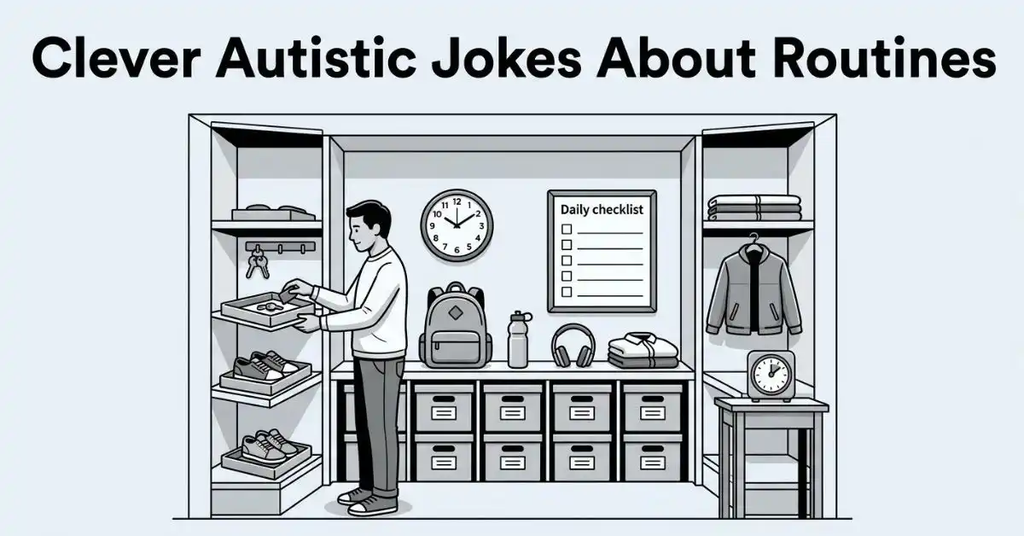
Routine humor appears repeatedly in current competitor content because predictable schedules, planning, checklists, familiar foods, and repeated rituals provide plenty of everyday comic material. Autism can involve insistence on sameness or difficulty with changes, but these characteristics are not identical for every autistic person.
That makes routine jokes most effective when they exaggerate an ordinary situation instead of claiming every autistic person behaves the same way. Think backup plans, calendars, checklists, predictable meals, early arrivals, and carefully organized schedulesuniversal experiences turned up to eleven.
- I made a checklist for my checklist.
- My backup plan has a backup plan.
- Surprise plans are just jump scares with calendars.
- I arrived early because my anxiety respects punctuality.
- My calendar knows where I’ll be before I do.
- I don’t fear change; I prefer to interview it first.
- My routine has a morning routine.
- I packed three days early because my future deserves peace.
- Dinner was scheduled, so dinner shall happen.
- I changed one tiny thing and my brain opened a support ticket.
- My planner is basically my emotional project manager.
- If routines had loyalty cards, I’d have platinum status.
Funny Autistic Neurodiversity Jokes for Friends
Neurodiversity humor can focus on special interests, deep conversations, facts, friendships, quiet communication, social energy, and shared interests. Current competitor content uses these themes because they create jokes about recognizable experiences rather than turning autism itself into an insult.
Friendship can also make humor more personal. Someone who knows your communication style may understand your deadpan delivery, favorite topics, or repeated jokes much better than a stranger. The result can be a kind of comedy built around trust, familiarity, shared references, and wonderfully specific interests.
- My friend asked for a fun fact, so I accidentally gave a 45-minute presentation.
- We don’t need small talk; we need a shared special interest.
- My friend understands my silence better than most conversations.
- Our friendship runs on snacks and extremely specific references.
- I said “one quick fact.” Nobody believed me.
- My favorite bonding activity is explaining something nobody asked about.
- We don’t finish conversations; we create sequels.
- My friend said, “Tell me everything,” and immediately regretted the wording.
- We communicate through memes, facts, and suspiciously accurate reactions.
- Our inside joke has now become an outside lifestyle.
- Friendship is finding someone who respects your headphones.
- A great friend knows when “I’m fine” means “please reduce the noise.”
Autistic Friendly Dad Jokes
Dad jokes work because their formula is wonderfully predictable: simple setup, obvious wordplay, harmless punchline. That structure makes them easy to share with families, friends, classrooms, or anyone who enjoys classic groan-worthy humor.
The competitor landscape also uses autism-friendly dad jokes as a dedicated category, often turning ordinary objects such as calendars, headphones, planners, blankets, puzzles, and notebooks into characters.
- Why did the planner get promoted? Because it always showed up on time.
- Why did the headphones get an award? They handled the pressure.
- Why did the calendar feel confident? It had everything planned.
- Why did the pencil relax? It found a quiet point.
- Why did the notebook feel important? It had everything written down.
- Why did the blanket get promoted? It supported everyone.
- Why did the clock love routines? It was always right on schedule.
- Why did the checklist throw a party? Every item was invited.
- Why did the puzzle feel proud? Every piece mattered.
- Why did the library win an award? It had outstanding quiet qualifications.
- Why did the backpack arrive early? It was prepared for everything.
- Why did the calendar avoid surprises? It didn’t have them scheduled.
Relatable Autistic Humor for School and Work
School and workplace humor gives autistic jokes a practical setting. Group projects, meetings, presentations, classrooms, office noise, email communication, deadlines, networking, and focused work all provide familiar situations for observational comedy. Competitors repeatedly use school and work as a dedicated humor category.
The best version of this humor doesn’t suggest that every autistic student or employee experiences school or work identically. Instead, it exaggerates situations many people recognize, such as practicing a phone call, preferring written instructions, or wondering why a meeting couldn’t have been an email.
- Group projects: the multiplayer game nobody asked to download.
- I practiced saying hello and still forgot the script.
- My email has punctuation because I mean business.
- Meetings could have been emails, and my brain agrees.
- I prepared for the presentation by presenting it to myself first.
- My desk is organized enough to qualify as a separate department.
- The office printer made a strange noise. I will remember it forever.
- I don’t procrastinate; I conduct extensive deadline research.
- My notes have more organization than my weekend.
- Networking sounds like a Wi-Fi problem.
- I brought headphones to work because peace is part of productivity.
- My favorite workplace meeting is the one that ends early.
Silly Autistic Jokes About Sensory Moments
Sensory experiences are another major theme in current autism-joke content. Competitors frequently mention noise, textures, bright lights, clothing tags, crowded spaces, headphones, quiet corners, and sensory-friendly environments.
Sensory experiences genuinely vary among autistic people, so humor should stay personal rather than universal. The CDC identifies differences in responses to sounds, textures, lights, and other sensory input as possible autism-related characteristics, while also emphasizing that not everyone experiences the same traits.
- My socks feel wrong, so today has been canceled.
- That blender didn’t make noise; it filed a complaint.
- My headphones are basically portable pieces.
- One itchy tag can start an international incident.
- The grocery store lights are working overtime.
- I heard one tiny noise and immediately opened an investigation.
- Silence is my favorite background soundtrack.
- Crunchy food comes with built-in surround sound.
- My comfort hoodie has earned employee of the month.
- The fire alarm and I have officially unfollowed each other.
- Quiet corners deserve five-star reviews.
- Bright lights are just the sun being unnecessarily ambitious.
FAQs
Can autistic people cry during a shutdown?
Yes. An autistic person may cry during a shutdown because of overwhelming sensory input, emotions, stress, or exhaustion. Not everyone experiences shutdowns in the same way, and some people may become very quiet or withdrawn instead.
What is a nickname for autism?
There isn’t one universal nickname for autism. Some people informally say “autism spectrum” or “ASD”, while “autistic” is a commonly used identity term. Language preferences can vary from person to person.
What are some autism sayings?
Common autism-related sayings include “Different, not less,” “Celebrate neurodiversity,” and “Autism is a different way of experiencing the world.” These emphasize acceptance, individuality, and understanding.
What is high-level autism?
“High-level autism” is not a formal clinical diagnosis and can be unclear or outdated terminology. People sometimes use it to describe autistic individuals who need relatively less day-to-day support, but support needs can vary greatly across different areas of life.
Final Thought
The best autistic jokes don’t need to make autism the punchline. They can find comedy in routines, sensory surprises, social batteries, special interests, quiet spaces, wordplay, and the wonderfully strange details of everyday life.
Humor is personal, and autistic people have different personalities, interests, communication styles, and comedy preferences. When a joke makes people laugh together rather than laugh at someone, it has a much better chance of creating the kind of connection that makes comedy memorable.

James is a U.S.-based humor writer who loves creating funny jokes, clever puns, playful roasts, and witty one-liners.
He enjoys turning everyday ideas into lighthearted and shareable comedy.
From puns and jokes to slang and funny captions, James keeps his content fun, relatable, and entertaining.
His goal is simple: make readers laugh and brighten their day.